Understanding the Digital Mind Concept and Its Practical Applications in Design
The term Digital Mind often evokes ideas of artificial intelligence, cognitive computing, or advanced data processing. However, in the context of design and visual communication, it takes on a more symbolic meaning. A Digital Mind icon represents the intersection of human thought and digital technology—an abstract yet accessible way to convey ideas about innovation, intelligence, and digital transformation.
What Makes the Digital Mind Icon Unique?
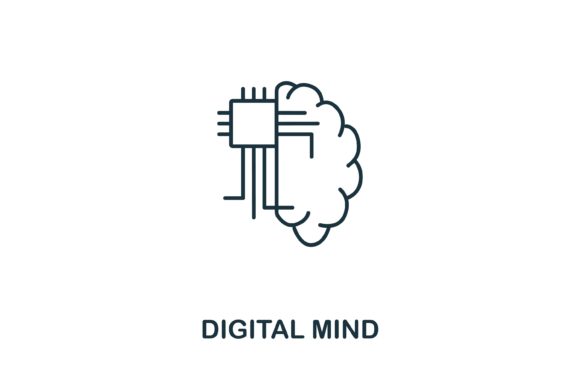
The Digital Mind icon from the machine learning collection is a minimalist, line-based illustration that visually encapsulates the idea of a brain enhanced or represented through digital means. It's designed for clarity and adaptability, making it a versatile choice for infographics, web templates, presentations, and UI design.
What sets this icon apart from more literal representations—like anatomical brain diagrams or complex circuit-style graphics—is its simplicity. It avoids visual clutter while still conveying the core concept of digital cognition. This makes it especially useful in contexts where a clean, modern aesthetic is preferred.
How Digital Mind Compares to Other Conceptual Icons
When compared to other conceptual icons like neural network diagrams, abstract data clouds, or futuristic head silhouettes, the Digital Mind strikes a balance between abstraction and clarity. It doesn't lean too heavily into technical jargon, nor does it become so abstract that its meaning is lost.
- Neural network visuals often focus on connections and data flow, which can be great for technical documentation but may feel overwhelming in general marketing materials.
- Abstract digital brains sometimes use glowing effects or 3D rendering, which can be visually striking but harder to integrate into minimalist designs.
- Simple line icons like the Digital Mind icon offer a more universally approachable option, especially for audiences who may not be deeply technical but still need to grasp the idea of digital intelligence.
Strengths and Limitations of the Digital Mind Icon
One of the strongest aspects of the Digital Mind icon is its flexibility. Because it's delivered in both EPS and JPG formats, it can be easily edited and scaled for various uses—from small app interfaces to large-format posters. Its line-art style means it can be recolored, layered, or combined with other graphics without losing visual integrity.
However, like any design element, it has its limitations. Because it's a conceptual image rather than a literal one, it may not be immediately recognizable to all audiences. In some contexts, viewers might need additional visual or textual cues to understand the icon’s intended meaning.
Best Fit Use Cases for Digital Mind
The Digital Mind icon works best in scenarios where the goal is to evoke the idea of digital intelligence without getting into the technical weeds. Consider using it in:
- Technology presentations – To represent AI, machine learning, or cognitive computing.
- Marketing materials – For tech startups or services that focus on innovation and smart solutions.
- Infographics – To symbolize thought processes, data analysis, or decision-making systems.
- Web design – As a visual anchor for sections discussing digital transformation or intelligent automation.
When to Consider Alternatives to Digital Mind
If your project requires a more literal or highly technical representation—such as explaining how a neural network operates or illustrating the physical components of an AI system—the Digital Mind icon may not be the best fit. In those cases, more detailed or specialized graphics would be more appropriate.
Additionally, if your audience is not familiar with abstract design language, or if your design style leans toward realism or high-tech aesthetics, you may want to explore other options that better match your visual tone.
Practical Comparisons: Digital Mind vs. Similar Icons
Let’s compare the Digital Mind icon with a few similar visual concepts to better understand its place in the design ecosystem:
- Circuit Brain Icons – These often feature detailed lines resembling microchips or circuit boards. They convey technical precision but can feel cold or overly complex in casual design contexts.
- Lightbulb or Idea Icons – These are great for general creativity but lack the digital or technological nuance that the Digital Mind offers.
- Futuristic Head Silhouettes – These often include glowing elements or abstract data streams inside a head shape. They are visually engaging but can be too stylized for minimalist or corporate design.
Designing with the Digital Mind Icon
When incorporating the Digital Mind icon into your design, consider how it interacts with surrounding elements. Because of its clean lines, it pairs well with modern sans-serif fonts and flat design styles. It also works well in color palettes that include tech-inspired tones like blues, purples, and grays, though it can be adapted to match any brand color scheme.
Since the icon is available as a vector (EPS) file, you can easily scale it without loss of quality. This makes it ideal for responsive web design or print materials where resolution matters. The JPG version is useful for quick placement in digital mockups or presentations where vector editing isn't required.
Final Thoughts: Is Digital Mind Right for Your Project?
The Digital Mind icon is a thoughtful choice for designers and communicators looking to represent the convergence of human cognition and digital technology in a clear, modern way. It stands out not because it's the most complex or detailed, but because it balances conceptual depth with visual simplicity.
If your goal is to communicate ideas related to machine learning, digital transformation, or intelligent systems without overwhelming your audience visually, this icon is likely a strong fit. However, if your project demands a more literal or highly technical visual, it’s worth exploring alternatives that better match your specific needs.
In the end, choosing the right icon is about matching visual language with your message. The Digital Mind icon offers a smart, clean, and adaptable solution for those who want to represent the future of thinking—both human and machine—in a way that's accessible and visually engaging.