Designing with the Hot Dog Icon from Fastfood Collection: A Vector Asset Guide
The Strategic Value of Line Art in Culinary Branding
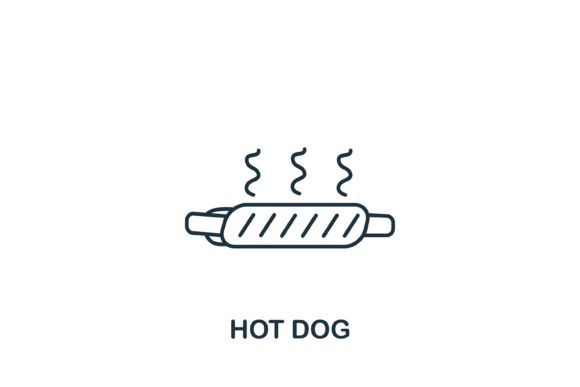
In the expansive world of digital design and print media, visual communication often hinges on the immediate recognition of symbols. When developing content for the food and beverage industry, specifically within the quick-service restaurant sector, clarity is paramount. The Hot Dog Icon from Fastfood Collection serves as a quintessential example of how simplified geometry can convey complex culinary concepts without visual clutter. Unlike photorealistic imagery, which can sometimes appear unappetizing or too specific to a single vendor's product, a simple line element hot dog symbol offers universal appeal. This abstraction allows designers to focus on the concept of the food item rather than the texture of a specific sausage or bun, making it an ideal candidate for templates, web design, and infographics where consistency and scalability are required.
The preference for line-based vector graphics in modern interface design stems from their ability to remain legible at extremely small sizes. On a mobile app navigation bar or a dense infographic detailing nutritional information, intricate details are lost. A clean, stroked path defining the silhouette of a hot dog maintains its integrity whether it is rendered at 16 pixels or blown up for a billboard. This versatility is why professionals across various sectors prioritize acquiring high-quality vector assets. The aesthetic minimalism associated with this style also aligns with contemporary design trends that favor whitespace and functional iconography over decorative excess.
Technical Specifications: EPS and JPG Formats Explained
Understanding the file formats included with the Hot Dog icon from fastfood collection is essential for maximizing utility across different platforms. Designers and business owners often receive multiple file types, but knowing when to deploy each one ensures optimal output quality and workflow efficiency.
The Role of EPS Files in Professional Workflows
The Encapsulated PostScript (EPS) format is the industry standard for vector graphics. When you download this asset, the EPS file represents the master source. Because it is mathematically defined rather than pixel-based, it offers infinite scalability without degradation. This makes the EPS file indispensable for large-format printing, such as storefront signage, vehicle wraps, or trade show banners. Furthermore, the EPS format preserves layer information and editable paths. If a brand requires the hot dog symbol to match a specific corporate color palette, a designer can open the EPS in Adobe Illustrator or CorelDRAW and adjust the stroke color or fill instantly. This editability transforms a generic stock element into a bespoke brand asset.
JPG Utility for Digital and Office Applications
While vectors are superior for production, the accompanying JPG file serves a critical role in accessibility and rapid deployment. Not every stakeholder in a project has access to professional vector editing software. Educators creating classroom materials, researchers compiling data presentations, or hobbyists designing a community event flyer may lack the tools to render an EPS. The JPG provides a rasterized preview that is universally compatible with word processors, presentation software, and basic image editors. It acts as a plug-and-play solution for non-designers who need the visual reference immediately. However, users must understand that JPGs have fixed resolutions; enlarging them beyond their native dimensions will result in pixelation. Therefore, the JPG should be reserved for screen display and small-scale printing, while the EPS remains the archive for professional production.
Diverse Applications Across Industries
The utility of a simple line element hot dog symbol extends far beyond restaurant menus. Its semantic flexibility allows it to function effectively in varied contexts, serving different audiences from consumers to academic researchers.
- Web Design and User Interfaces: In e-commerce platforms specializing in gourmet foods or delivery apps, icons serve as navigational anchors. A minimalist hot dog vector helps users filter categories quickly. The line-art style reduces cognitive load, allowing the eye to scan options faster than if realistic photos were used.
- Educational Materials: Teachers and curriculum developers utilize food icons to teach vocabulary, nutrition, or cultural studies. A neutral, stylized symbol avoids bias toward specific brands and focuses student attention on the learning objective. The clean lines reproduce clearly on worksheets and black-and-white handouts.
- Data Visualization and Infographics: Researchers analyzing dietary habits or market trends require consistent visual markers. Using the Hot Dog Icon from Fastfood Collection ensures that data points regarding processed meats or fast food consumption are represented uniformly throughout a report. Visual consistency aids in data comprehension and lends professional credibility to academic or business white papers.
- Event Planning and Hospitality: For summer festivals, corporate picnics, or charity fundraisers, organizers need cohesive branding. Vector icons allow for the creation of custom merchandise, directional signage, and digital invitations that look professionally designed even when created by volunteers or administrative staff.
Customization and Integration Best Practices
Acquiring the asset is only the first step; integrating it effectively requires adherence to design principles. Because the Hot Dog Icon from Fastfood Collection is provided as an easy-to-edit vector, users should leverage this capability to maintain brand coherence.
Stroke Weight and Visual Hierarchy
When incorporating this symbol into a larger system of icons, consistency in stroke weight is crucial. If your website uses 2-pixel lines for navigation, the hot dog icon must match this specification. Mixing thick and thin lines creates visual dissonance that undermines professionalism. Most vector editing software allows for global stroke adjustments. Before finalizing any design, verify that the line thickness of the hot dog symbol aligns with other elements in the fastfood collection or your existing icon library. This attention to detail signals expertise and care to the end user.
Color Theory and Contextual Adaptation
While the default black line art is versatile, adapting color enhances communication. In safety signage or allergen warnings, high-contrast colors like red or yellow may be necessary to draw attention. Conversely, in luxury dining contexts or artisanal branding, muted earth tones or metallic strokes might better reflect the brand identity. The vector nature of the file facilitates these changes without quality loss. However, designers should avoid gradients or complex shading within line icons unless the specific design language calls for it. The strength of this particular asset lies in its simplicity; over-styling can negate the benefits of using a line element symbol.
Considerations for Licensing and Ethical Usage
Professionals and creators must always consider the legal and ethical dimensions of using stock assets. While the Hot Dog icon from fastfood collection is designed for broad use, verifying the specific license terms associated with your download is mandatory. Licenses dictate whether the asset can be used for commercial merchandise, if attribution is required, or if there are limitations on the number of impressions. Business owners, in particular, should retain documentation of their license to protect against future intellectual property disputes.
Beyond legality, there is an ethical consideration regarding representation. Food icons carry cultural weight. A hot dog is distinctly associated with American cuisine and Western fast food culture. When designing for international audiences or diverse communities, ensure that the inclusion of this symbol is culturally appropriate and relevant. In some contexts, pairing it with complementary icons from different cuisines can create a more inclusive visual narrative. Responsible design involves understanding the semiotics of the symbols we employ, ensuring they communicate the intended message respectfully and accurately.
Optimizing Assets for Web Performance
For web designers and developers, the technical implementation of vector graphics directly impacts site performance and search engine optimization. While the EPS file is excellent for editing, it is not suitable for direct web embedding. Modern workflows typically involve converting the vector data into SVG (Scalable Vector Graphics) format for the web. Although the package includes EPS and JPG, savvy developers will export an optimized SVG from the EPS source. This retains the crispness of the line art at any zoom level while keeping file sizes under 2KB.
Using inline SVGs or sprite sheets for icons like the hot dog symbol improves Core Web Vitals by reducing HTTP requests and eliminating layout shifts associated with loading external images. Furthermore, SVG code is accessible; developers can add title and description tags directly within the markup, allowing screen readers to identify the icon as "hot dog" or "fast food option." This accessibility feature is often overlooked with JPG implementations but is native to vector workflows. By treating the Hot Dog Icon from Fastfood Collection as a data-driven asset rather than a static picture, teams can achieve superior performance metrics and inclusivity standards.
Maintaining Consistency in Large-Scale Projects
When working with extensive libraries of fastfood icons, organizational discipline prevents chaos. Establishing a naming convention and metadata strategy early in the project saves hours of retrieval time later. Instead of generic filenames, tag assets with descriptive attributes such as "hot-dog-line-icon-vector.eps" or "fastfood-hotdog-symbol.jpg." Creating a centralized style guide that documents the approved usage of the hot dog icon—including minimum clear space, prohibited modifications, and approved color variations—ensures that all team members, from junior designers to external contractors, apply the asset correctly.
This systematic approach is particularly valuable for agencies managing multiple food clients or franchises. By standardizing the use of the Hot Dog Icon from Fastfood Collection, agencies can streamline production timelines and reduce revision cycles caused by inconsistent branding. The ease of editing inherent in the EPS file supports this efficiency, allowing for rapid iteration and adaptation across different campaigns. Ultimately, the value of this graphic asset is realized not just in its aesthetic qualities, but in how seamlessly it integrates into professional workflows, supporting clear communication and operational excellence across the diverse spectrum of users who rely on effective visual shorthand.